

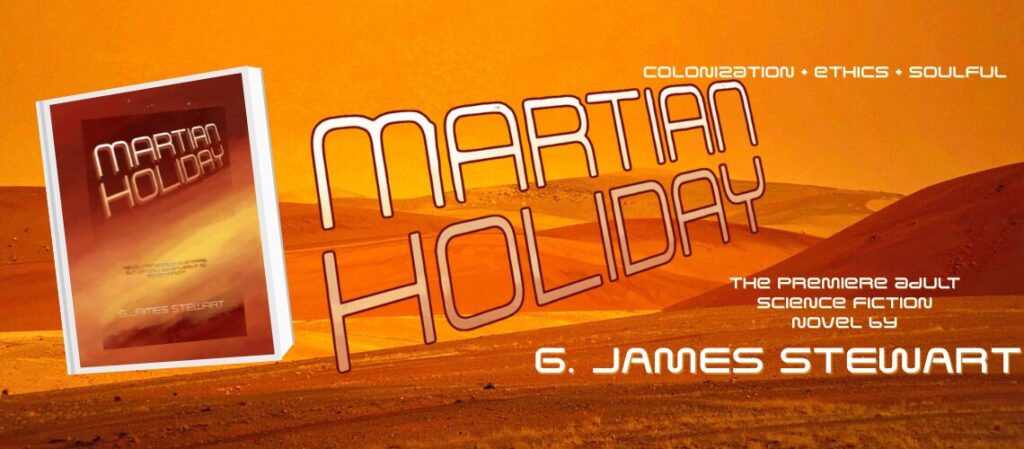

G. James Stewart’s premiere adult novel, Martian Holiday, released December 23, 2025!
Read the space odyssey and discuss it here!

Meet G. James Stewart
G. James Stewart is the penname for author Guy Stewart.
He is a husband; father, father-in-law, grandfather, and recently retired teacher, and school counselor who maintains POSSIBLY IRRITATING ESSAYS offering his writing up for comment. His first novel for YA/MS, EMERALD OF EARTH came out in 2024! He also writes on other worlds that have touched his life: GUYS GOTTA TALK ABOUT DIABETES, ALZHEIMERS; BREAST CANCER! He has 70+ publications in Analog, Cast of Wonders, Shoreline of Infinity, Cricket, Stupefying Stories, Nanoism, an essay in The Writer, and created experiments for episodes of the PBS science shows Newton’s Apple, and The New Explorers—for which he became the Science Museum of Minnesota’s Teacher of the Year.
Join the discussion
WRITING ADVICE: Short Stories – Advice and Observation #6: Nnedi Okorafor “& Me”
It’s been a while since I decided to add something different to my blog rotation. Today I’ll start looking at “advice” for writing short stories – not from me, but from other short story writers. In speculative fiction, “short” has very carefully delineated categories: “The Science Fiction and Fantasy Writers of America specifies word lengths for each category of its Nebula award categories by word count; Novel 40,000 words or over; Novella 17,500 to 39,999 words; Novelette 7,500 to 17,499 words; Short story under 7,500 words.”
I’m going to use advice from people who, in addition to writing novels, have also spent plenty of time “interning” with short stories. The advice will be in the form of one or several quotes off of which I’ll jump and connect it with my own writing experience. While I don’t write full-time, nor do I make enough money with my writing to live off of it…neither do most of the professional writers above…someone pays for and publishes ten percent of what I write. When I started this blog, that was NOT true, so I may have reached a point where my own advice is reasonably good. We shall see! Hemingway’s quote above will now remain unchanged as I work to increase my writing output and sales! As always, your comments are welcome!
Without further ado, short story observations by Nnedi Okorafor – with a few from myself…
I first came across Nnedi Okorofor’s writing when I was on the Andre Norton Award committee for the Science Fiction and Fantasy Writers of America (SFWA). That was the year her YA novel THE SHADOW SPEAKER. It was a strong year. I nominated THE TRUE MEANING OF SMEKDAY by Adam Rex, though the group put forth SHADOW SPEAKER…the SFWA membership overwhelmingly voted for HPAT DEATHLY HALLOWS (of course…and JK Rowling didn’t even CARE if she got it or if she hadn’t. She actually didn’t even notice…)
At any rate, Nnedi Okorafor said, “I wrote for eight years without even thinking of getting published. It wasn’t about an audience, I just wanted to write my stories. I enjoyed it. It was very gradual. I wrote about five novels before a professor told me I should try to get something published. I shrugged and said, “I guess” and submitted a short story to a journal. And that was the beginning. No novel that I’ve had published ever went through the normal route, however. I understood from the start that my path was not going to be typical. I knew the usual routes wouldn’t work for me because I was writing things that were…very unusual.”
My goal, as a 12-going-on-13-year-old, was to write more stories like John Christopher’s THE WHITE MOUNTAIN trilogy. I’d just finished them in the fall of my seventh grade year (I’d be 12 years old for eight more months…). I wanted to write my own story so it could go on forever. That first story, in longhand using a pencil was called (unsurprisingly) THE WHITE VINES and it was about alien vines growing out of a cornfield an taking over city sewers. That’s all I remember, and that was my motivation for writing – to be somewhere ELSE. I’d discovered science fiction in sixth grade with SPACESHIP UNDER THE APPLE TREE (by Louis Slbodkin) and THE WONDERFUL FLIGHT TO THE MUSCHROOM PLANET (by Eleanor Cameron). Junior High School offered an abundance of new books which I devoured – and which prompted me to write my oldest surviving story, a rip off of Andre Norton’s science fiction novels that included cats. (If you dare, here’s a link to it – not in the original pencil, I typed it up: http://theworkandworksheetsofguystewart.blogspot.com/2014/05/where-my-writing-beganmy-first.html)
“…a lot of people are told to stifle their imaginations, just in order to get by. Science fiction does the exact opposite. People who are missing that expression in their lives are fulfilled when they read a science-fiction narrative.”
That’s what I was told the whole time I was growing up…sure, my dad and I watched STAR TREK; he read some science fiction, too. But to WRITE the stuff? It was absurd! I can’t say my parents actively discouraged me – my mom got me my first Underwood-style manual typewriter, then she bought a MASSIVE electric one when the school district she worked for were selling them off to get new ones. But it was subtly implied.
Unlike Nnedi Okorafor, I grew up loathing sports. A brief sojourn into baseball when I was eight or nine and spending a season in the outfield because I could neither catch, throw, hit, or run left me with my current indifference to all things professional sports. She was a tennis and track star in her youth. So was everyone in my family: Dad played softball and bowled (after football and basketball all the way through high school), my brothers both played football and hockey (my next youngest brother going to college on a scholarship), then diverged while one did track and field, the other baseball. Both of them played for traveling hockey teams; my sister did softball and volleyball…Mom? Girls Athletic Association all three years of high school, and FENCING in college at the University of Minnesota.
Me? Tried out for the swim team my senior year – because of my dislocating shoulder, I became the team manager. After training and running all summer long and being coached by my best friend – and with ZERO support from my family, who thought I was crazy – I tried out for the junior college football team, sprained my ankle, and became the assistant trainer for two years, as well as becoming the team statistician and learning ow to keep those books…
I had turned to reading to escape; I continued in writing to escape…and maybe get published.
“Nearly a decade passed before I realized the lesson in this experience. Just as in sports, when writing creatively, if you don’t love the craft and art of it, you’ll never experience this pure form of success. Yet when you do have this love, you realize that pure success does not come from fame or fortune, it grows from that love.”
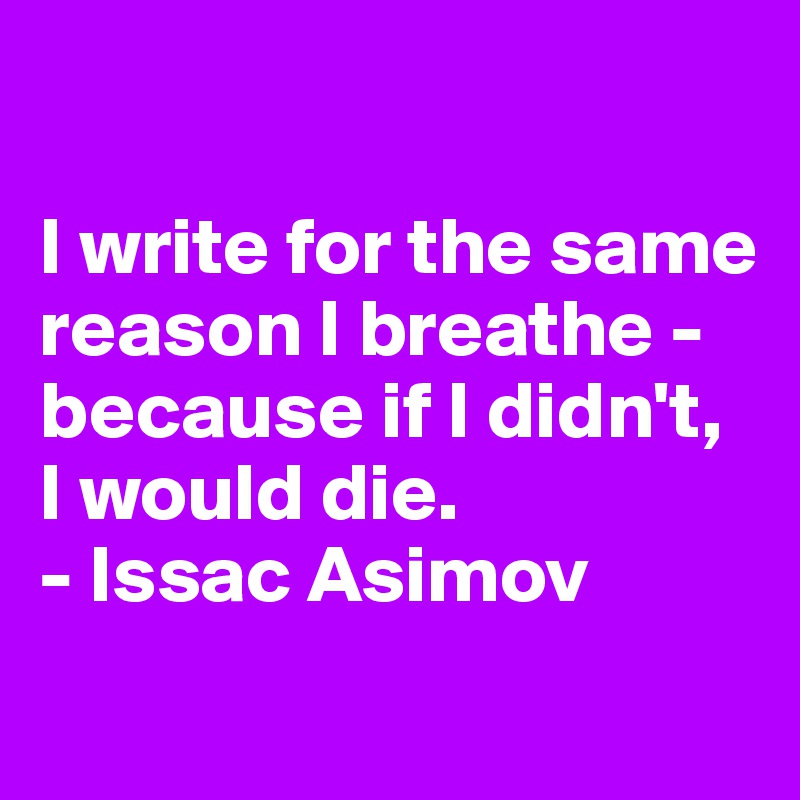
This one I fully understand – I love writing. My mantra became as still is something Isaac Asimov once wrote:
Nnedi Okorafor expresses a similar concept when she said, “‘When a story comes to me, I have to write it or it won’t let me rest,’ Okorafor said. ‘The characters are real to me. I hear their voices. Their actions affect me. The places I write about exist. I’ve felt the sting of their sand storms and smelled their forests. The creatures really do bite, snarl, sing, spit, sting, etc. When I’m writing, I’m there and I enjoy being there.’”
It’s almost like being possessed or filled with the Holy Spirit. When it happens, it’s virtually impossible to stay still; it’s virtually impossible to get away from the story. I’ve two stories that has dogged me for decades. The title’s remained the same as well, but I think that I’ve only recently reached a point where I MIGHT be skilled enough to write them. For now, just two titles, the first I will attempt to write soon: “Of the Galeborne”; the second “Salvation Writ in Stainless Steel”. I have the images in my mind, but the entire, coherent story isn’t there yet. I’m currently on Mars with several characters as Mars teeters on the bring of either a revolution or a reformation. Both are profound; one stands a better chance of leaving buildings standing than the other.
“It’s interesting because a lot of my stories are often based on several things, but their foundation is in the stories of the women and girls around me and also within myself. And Binti comes from a very insular family – a cultural family that’s very close. And she ends up picking up and going and leaving her family and going just so that she can go to a university that is on another planet.” Nnedi Okorafor had done precisely this when she answered the call to become a college professor far from her family. The EMOTIONS she was experiencing drove the work of fiction.
So, what IS the source of my stories? When I look at my published work – which I view as a successful expression of something that is really in me; something I struggle with; something I’m working through. Two of my most recent stories, “Kamsahamnida, America” and “Road Veterinarian”, I deal with the issue of alienation (fortunately neither one has aliens in it!) – the separation of the main character from his world. The first one is literally separated from Earth when he goes to the Moon; in the second story, he’s self-isolating because he was born with PBT (PieBald Trait) aka piebaldism and has issues with people seeing him outside the framework of his work as a veterinary geneticist, where he is an acknowledged world expert. In another story, “Cockroach, Wasp, Gecko, Tiger”, the main character is living in a political internment camp in North Korea; “The Last Mayan Aristocrat”…well, it’s self-explanatory isn’t it?
So, the discovery here is the importance of knowing WHERE you’re writing from.
An unsold story of mine may be unsold because the sense of isolation I feel sometimes wasn’t clearly expressed. “May They Rest” (revised and renamed “By Law and Custom”) is also an isolation story where the sole survivor of a massacre of a Human colony on a world claimed by the intelligent plant WheetAh returns to…hmm…I don’t remember specifically WHY he returns, though his motivation is not altruistic in any way. Which might be part of the problem of the story…
So, there you go. What I’ve learned from Nnedi Okorfor in the time I spent in her universes. I hope that no matter how old I get, I continue to learn!

Martian Holiday
Get all the information on this newly releasing space science fiction
- WRITING ADVICE: Short Stories – Advice and Observation #6: Nnedi Okorafor “& Me”

It’s been a while since I decided to add something different to my blog rotation. Today I’ll start looking at “advice” for writing short stories – not from me, but from other short story writers. In speculative fiction, “short” has very carefully delineated categories: “The Science Fiction and Fantasy Writers of America specifies word lengths for each category of its Nebula award categories by word count; Novel 40,000 words or over; Novella 17,500 to 39,999 words; Novelette 7,500 to 17,499 words; Short story under 7,500 words.”
I’m going to use advice from people who, in addition to writing novels, have also spent plenty of time “interning” with short stories. The advice will be in the form of one or several quotes off of which I’ll jump and connect it with my own writing experience. While I don’t write full-time, nor do I make enough money with my writing to live off of it…neither do most of the professional writers above…someone pays for and publishes ten percent of what I write. When I started this blog, that was NOT true, so I may have reached a point where my own advice is reasonably good. We shall see! Hemingway’s quote above will now remain unchanged as I work to increase my writing output and sales! As always, your comments are welcome!
Without further ado, short story observations by Nnedi Okorafor – with a few from myself…
I first came across Nnedi Okorofor’s writing when I was on the Andre Norton Award committee for the Science Fiction and Fantasy Writers of America (SFWA). That was the year her YA novel THE SHADOW SPEAKER. It was a strong year. I nominated THE TRUE MEANING OF SMEKDAY by Adam Rex, though the group put forth SHADOW SPEAKER…the SFWA membership overwhelmingly voted for HPAT DEATHLY HALLOWS (of course…and JK Rowling didn’t even CARE if she got it or if she hadn’t. She actually didn’t even notice…)
At any rate, Nnedi Okorafor said, “I wrote for eight years without even thinking of getting published. It wasn’t about an audience, I just wanted to write my stories. I enjoyed it. It was very gradual. I wrote about five novels before a professor told me I should try to get something published. I shrugged and said, “I guess” and submitted a short story to a journal. And that was the beginning. No novel that I’ve had published ever went through the normal route, however. I understood from the start that my path was not going to be typical. I knew the usual routes wouldn’t work for me because I was writing things that were…very unusual.”
My goal, as a 12-going-on-13-year-old, was to write more stories like John Christopher’s THE WHITE MOUNTAIN trilogy. I’d just finished them in the fall of my seventh grade year (I’d be 12 years old for eight more months…). I wanted to write my own story so it could go on forever. That first story, in longhand using a pencil was called (unsurprisingly) THE WHITE VINES and it was about alien vines growing out of a cornfield an taking over city sewers. That’s all I remember, and that was my motivation for writing – to be somewhere ELSE. I’d discovered science fiction in sixth grade with SPACESHIP UNDER THE APPLE TREE (by Louis Slbodkin) and THE WONDERFUL FLIGHT TO THE MUSCHROOM PLANET (by Eleanor Cameron). Junior High School offered an abundance of new books which I devoured – and which prompted me to write my oldest surviving story, a rip off of Andre Norton’s science fiction novels that included cats. (If you dare, here’s a link to it – not in the original pencil, I typed it up: http://theworkandworksheetsofguystewart.blogspot.com/2014/05/where-my-writing-beganmy-first.html)
“…a lot of people are told to stifle their imaginations, just in order to get by. Science fiction does the exact opposite. People who are missing that expression in their lives are fulfilled when they read a science-fiction narrative.”That’s what I was told the whole time I was growing up…sure, my dad and I watched STAR TREK; he read some science fiction, too. But to WRITE the stuff? It was absurd! I can’t say my parents actively discouraged me – my mom got me my first Underwood-style manual typewriter, then she bought a MASSIVE electric one when the school district she worked for were selling them off to get new ones. But it was subtly implied.
Unlike Nnedi Okorafor, I grew up loathing sports. A brief sojourn into baseball when I was eight or nine and spending a season in the outfield because I could neither catch, throw, hit, or run left me with my current indifference to all things professional sports. She was a tennis and track star in her youth. So was everyone in my family: Dad played softball and bowled (after football and basketball all the way through high school), my brothers both played football and hockey (my next youngest brother going to college on a scholarship), then diverged while one did track and field, the other baseball. Both of them played for traveling hockey teams; my sister did softball and volleyball…Mom? Girls Athletic Association all three years of high school, and FENCING in college at the University of Minnesota.
Me? Tried out for the swim team my senior year – because of my dislocating shoulder, I became the team manager. After training and running all summer long and being coached by my best friend – and with ZERO support from my family, who thought I was crazy – I tried out for the junior college football team, sprained my ankle, and became the assistant trainer for two years, as well as becoming the team statistician and learning ow to keep those books…
I had turned to reading to escape; I continued in writing to escape…and maybe get published.
“Nearly a decade passed before I realized the lesson in this experience. Just as in sports, when writing creatively, if you don’t love the craft and art of it, you’ll never experience this pure form of success. Yet when you do have this love, you realize that pure success does not come from fame or fortune, it grows from that love.”This one I fully understand – I love writing. My mantra became as still is something Isaac Asimov once wrote:
Nnedi Okorafor expresses a similar concept when she said, “‘When a story comes to me, I have to write it or it won’t let me rest,’ Okorafor said. ‘The characters are real to me. I hear their voices. Their actions affect me. The places I write about exist. I’ve felt the sting of their sand storms and smelled their forests. The creatures really do bite, snarl, sing, spit, sting, etc. When I’m writing, I’m there and I enjoy being there.’”
It’s almost like being possessed or filled with the Holy Spirit. When it happens, it’s virtually impossible to stay still; it’s virtually impossible to get away from the story. I’ve two stories that has dogged me for decades. The title’s remained the same as well, but I think that I’ve only recently reached a point where I MIGHT be skilled enough to write them. For now, just two titles, the first I will attempt to write soon: “Of the Galeborne”; the second “Salvation Writ in Stainless Steel”. I have the images in my mind, but the entire, coherent story isn’t there yet. I’m currently on Mars with several characters as Mars teeters on the bring of either a revolution or a reformation. Both are profound; one stands a better chance of leaving buildings standing than the other.
“It’s interesting because a lot of my stories are often based on several things, but their foundation is in the stories of the women and girls around me and also within myself. And Binti comes from a very insular family – a cultural family that’s very close. And she ends up picking up and going and leaving her family and going just so that she can go to a university that is on another planet.” Nnedi Okorafor had done precisely this when she answered the call to become a college professor far from her family. The EMOTIONS she was experiencing drove the work of fiction.
So, what IS the source of my stories? When I look at my published work – which I view as a successful expression of something that is really in me; something I struggle with; something I’m working through. Two of my most recent stories, “Kamsahamnida, America” and “Road Veterinarian”, I deal with the issue of alienation (fortunately neither one has aliens in it!) – the separation of the main character from his world. The first one is literally separated from Earth when he goes to the Moon; in the second story, he’s self-isolating because he was born with PBT (PieBald Trait) aka piebaldism and has issues with people seeing him outside the framework of his work as a veterinary geneticist, where he is an acknowledged world expert. In another story, “Cockroach, Wasp, Gecko, Tiger”, the main character is living in a political internment camp in North Korea; “The Last Mayan Aristocrat”…well, it’s self-explanatory isn’t it?
So, the discovery here is the importance of knowing WHERE you’re writing from.
An unsold story of mine may be unsold because the sense of isolation I feel sometimes wasn’t clearly expressed. “May They Rest” (revised and renamed “By Law and Custom”) is also an isolation story where the sole survivor of a massacre of a Human colony on a world claimed by the intelligent plant WheetAh returns to…hmm…I don’t remember specifically WHY he returns, though his motivation is not altruistic in any way. Which might be part of the problem of the story…
So, there you go. What I’ve learned from Nnedi Okorfor in the time I spent in her universes. I hope that no matter how old I get, I continue to learn!
- Where to buy a copy of MARTIAN HOLIDAY
https://www.amazon.com/Martian-Holiday-Hard-Science-Novel-ebook/dp/B0G2HST52P?ref_=ast_author_mpb
- ALIEN SPECULATIONS: If We Altered Aspects Of Humanity, What Kind Of Alien Aliens Would We Get?At one of the sites I was skimming in preparation for this post, I was one written by Veronica Sicoe. Her site is linked below.
One statement leaped out at me, “Completeness – some things habitually get lost in worldbuilding, unless they’re specifically needed, and we ought to remember to at least give them a cursory glance, such as: the legal systems, burial rituals, infant care systems, medical systems, recreational facilities, etc.”
You can access her site and insight here: How To Create An Alien Species In 3 Stages – Veronica Sicoe (wordpress.com)
HOWEVER, what happened when I read this was something not AT ALL intended by the issue she was opining on. I TOOK IT TO MEAN, “In what way might aliens experience ‘completeness’ that would be entirely WEIRD to us?”
Let me examine my own Human self. I’m cis-gendered, a hetero husband happily married for the past 36 years (almost 37). I am also white, so (by implication), I have had every opportunity that this American society can offer.
HOWEVER…if you stop there, some people will immediately turn on me, vilify me, and make all sorts of assumptions about me that simply are not true. One (for example), is that I will be homophobic. I could provide proof that I’m not, but while it might be entertaining, MY POINT IS THIS: I was not MY OWN PERSONAL-AND-NOT-IMPLYING-THAT-EVERYONE-ELSE-SHOULD-BE-LIKE-ME…most complete. I needed to be in a traditional marriage with a traditional woman. Now again, please don’t leap to assumptions about what I mean by “traditional”. I could once again provide references that would refute many assumptions people would make about me.
MY POINT IS THIS: Completeness for ME MYSELF PERSONALLY is that to be complete, I needed to be in a permanent (as permanent as Humans can be!) marriage relationship to be my best self.
But no matter WHO YOU ARE OR WHAT CREATES THE BEST YOU THAT YOU CAN BE…what might truly ALIEN ALIENS need to “be complete”?
For example, what if instead of being born as I and my wife were – one each of a dual gendered variety of Humanity; aliens were born as followed:
At birth (we’ll make it a mammalian-style birth to keep this simple and something I can understand – if you’re going to accuse me of playing it safe and assuming all Humans are like me, please read this post: https://faithandsciencefiction.blogspot.com/2020/02/possibly-not-irritating-essay-other.html) I just don’t want to add too many variables into this intellectual experiment because I had difficulty imagining how a school of sharks might relate to each other…as I’m certainly not a shark, but I’m not a fish, either, and I’m really NOT an ancient fish…
So, let’s say aliens have a mammalian birth. Let’s say they’re triplets; not identically gendered. We already know that Human triplets – especially if they came from the same egg and are genetically identical. We already KNOW that creates all kinds of assumptions and comments in our heads when we see them. At one time, the Keinast Quintuplets made the news. “The quintuplets were the first American set of surviving quintuplets to be conceived through the use of fertility drugs.” They were SO unusual, that “Good Housekeeping magazine had an exclusive deal to publish four articles about them in their first two years.”
That was in 1970. They were styled “The Keinast Quints”. Today, they are in their fifties. After their father committed suicide in 1984 when the quints were fourteen. When they were all 31, they gave their last public interview. (If you’re interested and want more information, follow this link: https://www.mrlocalhistory.org/where-are-the-kienast-quintuplets-from-liberty-corner/)
What it DOESN’T talk about is the Quint’s perceptions of each other. They shared the same uterus until birth; they shared the same upbringing. How did that affect them? How did having the same birthday as four other people matter? WERE THEY PSYCHICALLY LINKED???? (JK)
But, oddly, there’s not really much about them besides a few magazine articles, interviews, and this and that. Wasn’t anyone interested in their mental/psychological/intellectual interactions? Apparently not. So, let me speculate.
I had two other brothers and a sister. Birth order among the Quints would have been irrelevant – but perhaps gender or even SIZE would have taken on aspects that we aren’t used to considering (though in many families, the “biggest kid” was the one who got the most things…)
What if, in aliens where multiple, simultaneous mammalian-style birth was NORMAL, something ELSE drove the development of relationships among themselves? What are some things that MIGHT drive their psychology?
1) First to kill a meal.
2) First to identify, choose, and latch onto the strongest being in the birthing tent?
3) First to feed the one who carried them until birth – with one of the other young?
4) First to escape a gauntlet?
5) Last to be born by forcing the rest out first to feed hungry family?
6) Birth is into a cage; first to solve the lock and escape?
7) All are delivered at once; the one who protects the mother best (obviously killed by the rest, which are disintegrated and the protector is resurrected)? Eaten by the father, and its brain joins with his and whose hormones regenerates the father’s body?
Each BIOLOGICAL scenario would generate an entirely different sociological structure leading to a particular civilization that makes sense with the prevailing biology. It would impact what a family is, how it’s organized, and what it’s FOR. In Human biology, take a Bible story as an example: the Hebrew infant Moses was destined for death. He was born, certain to bel slaughtered as all of his peers were. His mother puts him in a basket, he’s discovered by the Pharaoh’s daughter and raised as an Egyptian…history is altered. For the rest of the story, if you’re interested, go to a Bible or a Torah or a Koran, locate, and read the story of Moses.
This is just one aspect of alienness you can explore. How does all of the above relate to how CLOSE the siblings are — to their parent/s; to their society or protectors? Choose a few aspects and explore them, following the logic of what you image will happen.
You SHOULD come up with a really ALIEN alien!
Sources: https://worldbuilding.stackexchange.com/questions/27103/the-alien-perspective-generating-alien-pov-characters-via-twists-on-human-psyc; https://en.wikipedia.org/wiki/Kienast_quintuplets - Discuss Martian Holiday
Thoughts on this colonization science fiction novel? Let’s talk here!
- CREATING ALIEN ALIENS: PART 1
For the past thirty years, I taught a class for gifted and talented children in a suburb of Minneapolis where I taught middle school and high science science from, I like to point out, from Astronomy to Zoology. The class that came out of all that teaching stuff I named ALIEN WORLDS. In it, I coached my young people (from 4th through 10th grade) to build alien worlds, lifeforms, cultures, and civilizations that HAD to be logical and couldn’t riff off of ANY published, filmed, or broadcast aliens created by “the media”. The results from THIS vantage point have been astonishing and encouraging. I’ll spend time NOT narrating what I DID, but what I tossed to the kids as inspiration for them to use when creating.
My ONLY stipulation to them was this: “NO laser death of bone disintegration and flesh liquefying destructo beam blaster gun light saber of dooms…No. Not even ONE!”
With that caveat, let’s go…
I have created three universes.
In the first, it’s Humans alone. We genetically engineer ourselves to fit the varied environments we encounter. The overarching conflict is between the Empire of Man and the Confluence of Humanity. The first considers someone Human if they are 65% or more “Original Human” DNA. If you’re less, you’re considered SubHuman. The second sees ANY genetic manipulation to be A-OK.
In the second, it’s us and mobile plants. Humans have gone deep into space and encountered the WheetAh, mobile plants reminiscent of a giant saguaro cactus crossed with a pitcher plant. The conflict is as obvious as it is inevitable – we eat plants. They eat rodents; hence the pejoratives each lays on the other. We call them Weeds; they call us Weasels.
In the third, we are junior members of the Unity of Sapients, some fifty extremely different intelligences (I can’t say species – as in Kingdom Phylum Class Order Family Genus Species – as there are smart minerals, arthropods, collective, herd, and individual intelligences in the Unity. We haven’t even been certified sapient. (definition: adjective – having or showing great wisdom or sound judgment; Orig –1425–75; late Middle English sapyent < Latin sapient- (stem of sapiēns, present participle of sapere to be wise, literally: to taste, have taste), equivalent to sapi- verb stem + -ent- -ent
So, I’ve written stories in all three universes. How many in each have been published?
Confluence/Empire: I’ve written seven; only one has been published.
WheetAh: Written two; one published.
Unity: Written seventeen, four published…which seems good, until I point out that the four published stories didn’t contain aliens.So, I CAN’T write believable aliens.
Why not?
Writers who have written believable aliens: David Brin, Julie Czerneda, Hal Clement, James White, Alan Dean Foster, CJ Cherryh, Larry Niven, Octavia Butler, SL Viehl, and others that escape me; clearly depict them. But HOW?
I’ve been doing some superficial analysis and it seems that when Humans and aliens interact closely and the alienness is narrowed down to one or two SPECIFIC differences; the ones that somehow cause the problem; that’s when the aliens are acceptable.
For example, CJ Cherryh’s atevi. Basically giant Humans with golden eyes and coal black skin, bipedal, five digits, and sexually compatible with Humans (though not reproductively compatible); have one difference: they have no concept of love. In place of love, they have a profound sense of association. All large, mammalian life forms on the Earth of the atevi have this same biological urge – to associate under one strong leader. The single Human who interacts with them, Bren Cameron, understands this and can speak their language fluently – but he still makes mistakes when under pressure to assume that the atevi “feel” about him as he does about them. This creates countless situations of tension and have driven the story line for some TWENTY novels over a quarter of a century of time. The reason I go back repeatedly is because I want to see what happens next as the Human population grows and the atevi advance in technology and eventually reach parity with Humans; and possibly visit Earth.
Another example is James White’s famous Sector General novels. Twelve novels spanning over thirty years of writing, they depict the life of a small group of Humans on a massive space station away from the “main thoroughfares” of a vast interstellar civilization as they interact with countless alien cultures and medical personnel. Languages, medicine, morality, humor, and emotions are touchstones – and points of conflict – for the series.
So – what have I learned with my brief analysis?
1) Aliens and Humans HAVE to interact closely; intimately. (I tried this with “May They Rest” and it was quickly bounced by five magazines and my favorite, to which I’d sold several stories…) In “A Complications of Santients”, my character and an alien, “cockroach” sentient interacted VERY intimately – and didn’t sell…
2) I need more aliens than Humans. I did this in “Peanut Butter and Jellyfish”, podcast from CAST OF WONDERS. It took place on a trimaran carrying cultural exchange WheetAh. Humans need to be at a disadvantage. The aliens should be at an advantage.
3) It needs to be a BROADLY threatening situation. I think I did this in “The Princess’s Brain”, but I’ve got to go back and reread it. I DID do this in “The Krasiman, Monkey Boy, and the Frogfather”, but that didn’t sell, either.
So, I’m ready to try something new. Cron plus the above…should give me an alien story that will sell.
